- Blog
- Car Taxes in Poland - A Guide For Car Dealers
Car Taxes in Poland - A Guide For Car Dealers
Find out what car taxes you need to pay in Poland when buying, selling, or importing used vehicles, and see what EV incentives are there in 2025.

Puncte-cheie
- The main car taxes you’ll encounter are VAT, excise duty, and registration fees.
- VAT applies to most car sales at a standard rate of 23%, and dealers can usually reclaim it if it’s shown on the invoice.
- PCC tax does not apply to VAT-registered dealers, it only applies in transactions between private individuals.
- EVs come with several tax perks, including no excise or registration tax, full VAT deduction for businesses, and subsidies for private buyers.
Whether you’re importing cars to Poland or selling vehicles locally, it’s important to understand how taxes work.
Knowing when and what to pay helps you calculate the costs accurately and avoid surprises. Also, knowing all the taxes you’ll need to pay helps you price the cars you’re selling in a way that keeps your dealership profitable.
In this guide, we’ll go over the main vehicle taxes in Poland, recent changes in 2025, and what they mean for used car traders, so that you can plan better and sell smarter.
List of all vehicle taxes in Poland
|
Acronym |
Full tax name |
When is it paid? |
Tax deduction available? |
Who pays? |
|
VAT |
Value Added Tax (VAT) |
On most car sales and when importing vehicles to Poland |
Yes, for VAT-registered businesses when VAT is shown on the invoice |
Dealer when importing or acquiring intra-EU vehicles, buyer when purchasing from dealer |
|
Excise duty |
Excise tax on passenger cars (Akcyza) |
When importing and first registering a vehicle in Poland |
No |
Importer / person registering the car (usually the dealer) |
|
PCC |
PCC tax (Civil Law Transaction Tax – PCC-3 form) |
When buying a used car in a private-to-private sale (within 14 days after purchase) |
No |
Private buyers (no VAT-registered dealer involved) |
|
Registration fee |
Vehicle registration fee (Opłata rejestracyjna) |
When registering a vehicle in Poland (one-time fee, usually around 180–250 PLN) |
No |
Registered owner (dealer or buyer) |
|
Customs duty |
Customs duty on imported vehicles |
When importing vehicles from non-EU countries |
Usually not deductible, but VAT charged on top may be deductible for businesses |
Importer / dealer |
► VAT - Value added tax
The standard VAT rate in Poland is 23%. When a VAT-registered dealer buys or sells a car, VAT treatment depends on the type of invoice: VAT-excluded or margin.
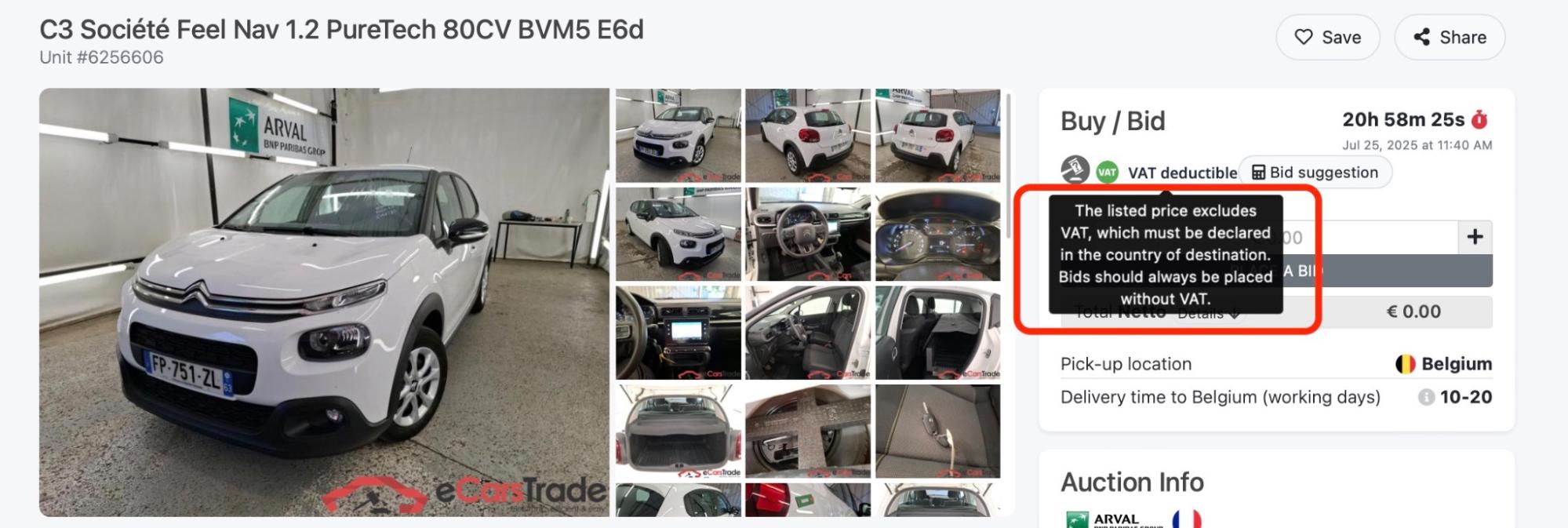
In most cases, cars are sold as VAT-excluded. This means the seller doesn’t charge VAT on the invoice, and the buyer (for example, a Polish dealer) has to declare and pay VAT in their own country.
For instance, this car on eCarsTrade is listed as VAT-excluded, so the buyer declares and pays VAT in their own country.
But in some cases, cars are sold under margin schemes. In this case, VAT has already been paid in the country of origin.
eCarsTrade listings with margin VAT look like this:
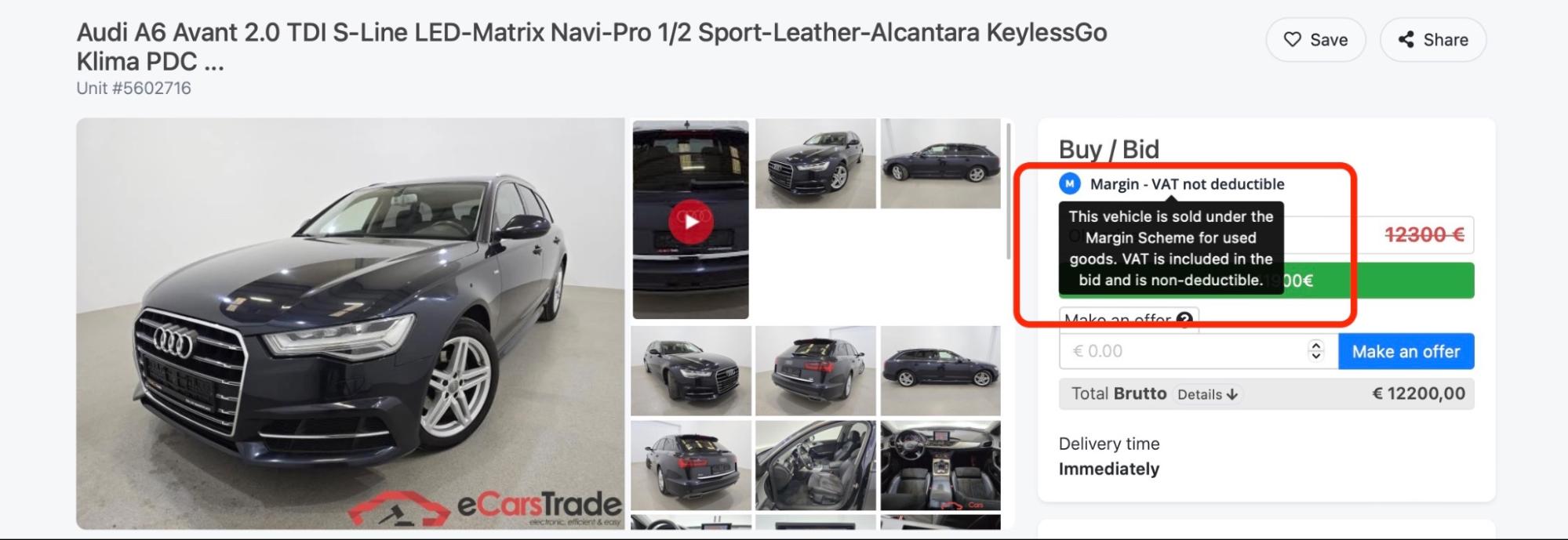
The dealer doesn’t pay any VAT at import and can’t deduct it later. When reselling the car, VAT is only charged on the dealer’s profit margin (not on the full price) and it’s not shown separately on the invoice.
► Excise tax (Akcyza)
If you import a vehicle into Poland, even from another EU country, you have to pay excise duty.
The amount depends on the engine size and whether the car is a hybrid, electric, or internal combustion engine (ICE).
For example, if you bring in a petrol car with an engine under 2000 cm³, you’ll pay the rate of 3.1%. But if the engine is over 2000 cm³, the rate jumps to 18.6%.
Hybrid cars get reduced rates, as you can see in this rate overview.
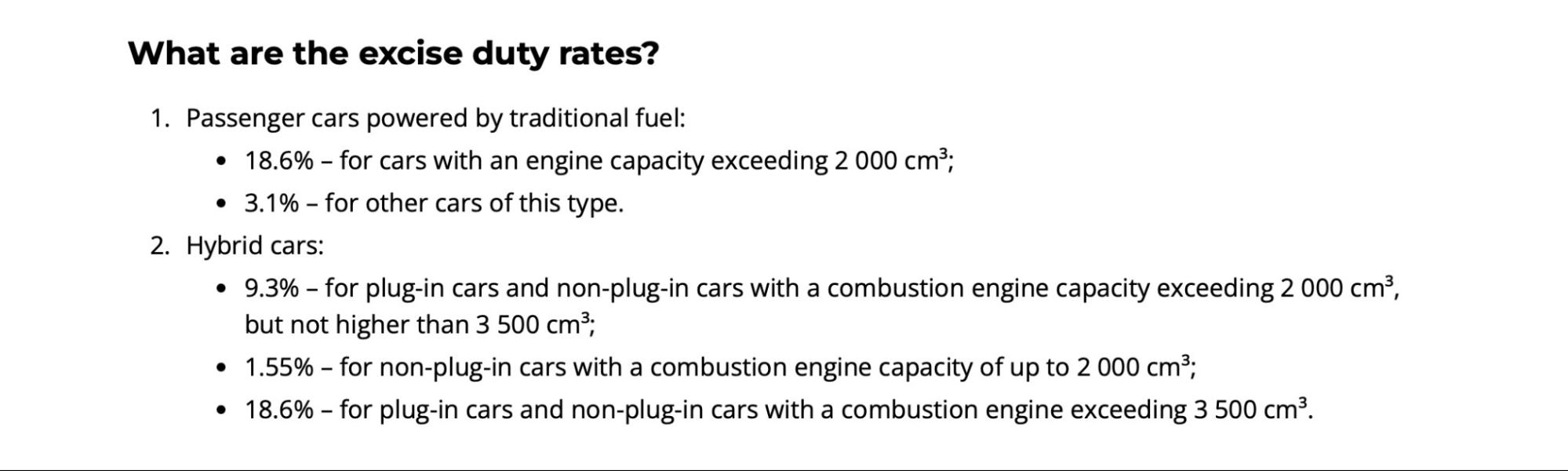
Fully electric vehicles are currently exempt from paying excise duty.
When do you pay it?
Once the car arrives in Poland, you have 14 days to file the AKC-U/S excise declaration and 30 days to pay the excise. Both steps must be done before you register the car.
You file and pay through the PUESC online portal.
Keep the payment confirmation, because you cannot register the car without it.
► PCC Tax (Civil Law Transaction Tax - PCC-3 form)
VAT-registered car traders do not pay PCC tax, but it is still worth knowing. PCC applies to private-to-private sales, so it mainly comes up when there is no VAT invoice.
For a used car, the rate is 2% of the car's market value. The buyer pays the tax, files the PCC-3 form, and pays within 14 days of signing the contract.
You do not pay PCC when:
- The seller is a business that gives you a VAT invoice, because VAT replaces PCC
- The car's market value is PLN 1,000 or less
► Registration Fee (Opłata rejestracyjna)
Registering a vehicle in Poland involves several small administrative fees. These include charges for license plates, a registration certificate, and an inspection sticker. The total cost is usually around 180 PLN.
Fully electric vehicles are exempt from registration tax.
Now, let’s take a look at how these taxes compare to each other.
|
Tax type |
Applies to |
Rate or Amount |
When to pay |
|
VAT |
Most car sales |
23% |
At sale |
|
Excise duty |
Imported cars |
18.6% / 3.% for ICE, varies for other fuel types |
At registration |
|
PCC tax |
Private sales |
2% |
Within 14 days of transaction |
|
Registration fee |
All registered cars |
~180 PLN |
Annually |
You might have noticed that Poland doesn’t charge a fixed annual road tax. Instead, drivers still contribute to road funding through the price of fuel, so that’s how the government collects money for road maintenance and infrastructure.
What's new? Tax and regulatory changes in 2026
Like 2025, 2026 hasn't brought big changes to car taxes in Poland. But a few updates matter for traders.
Business car deductions now depend on CO2
From January 2026, the amount you can deduct for a passenger car used in your business depends on its CO2 emissions: PLN 225,000 for electric and hydrogen cars, PLN 150,000 for low-emission cars below 50 g CO2/km, and PLN 100,000 for everything else, which covers most petrol, diesel, and standard hybrids.
The old limit for combustion cars was PLN 150,000, so the cap has dropped for higher-emission models.
The same levels apply to leasing and rental costs. Cars already in your fixed asset register by the end of 2025 keep the old limits.
Lower excise for mild hybrids
The Ministry of Finance confirmed that mild hybrids count as petrol-electric hybrids, so they now qualify for the reduced excise rates.
If you import them, that means a smaller excise bill than for a standard petrol car.
EV subsidies are ending
The NaszEauto subsidy for electric cars is still running, but it closes in 2026 once the funds run out, and the government says it's likely the last big EV subsidy in Poland.
It's aimed at private buyers and sole traders, not trading companies, but it's still a good selling point when you offer EVs to customers.
Tax scenarios for buying and selling used cars in Poland
Ready to see how these taxes work in practice? Here’s an overview of the most common scenarios.
► Case 1: Selling a used car
If you’re a VAT-registered car dealer selling a used car in Poland, the main taxes involved are:
- VAT, which you include in the invoice (23% of the value).
- PCC tax doesn’t apply, since dealers selling cars with VAT are exempt. PCC is only for private transactions.
- No excise duty, because the car is already registered in Poland.
- The buyer pays registration fees, not the seller.
EVs: The only difference is that EVs are exempt from excise duty, but if the car is already in Poland, that exemption has already been applied, so you don’t need to worry about it.
► Case 2: Buying a used car
If you’re a dealer buying a used car from a Polish seller:
- If the seller is a business, you’ll likely get a VAT-deductible invoice, and you'll be able to reclaim VAT later.
- If you buy from a private individual, you won’t get a VAT invoice and can’t reclaim VAT.
- No excise duty applies if the car is already in Poland.
- PCC tax doesn’t apply to traders buying for resale with a proper invoice.
EVs: EVs are treated like all other cars, and are already exempt from excise duty if they were already registered in Poland.
► Case 3: Importing a used car from the EU (e.g. Germany)
Let’s say you buy a used car from Germany via a platform like eCarsTrade. Here’s what happens:
- The German seller usually won’t charge VAT if both sides are VAT-registered.
- You declare 23% VAT in Poland, but since you’re reselling the car, you can usually deduct it, so it cancels out in your VAT return.
- You pay excise duty in Poland, based on engine size and fuel type (unless the car is fully electric).
- You also pay the standard registration fee (around 180 PLN) when registering the car.
- No PCC tax applies if you’re buying with a business invoice and the car becomes part of your inventory.
► Case 4: Importing a used car from a non-EU country (e.g. USA)
If you’re importing a car from a non-EU country, here’s what you need to pay:
- VAT at 23%, calculated on the full customs value (car + shipping + customs).
- Customs duty, usually 10% of the vehicle’s value.
- Excise duty, based on engine size and fuel type.
- Registration fees in Poland.
- No PCC tax, as long as it’s a business import with proper documentation.
EVs: Fully electric vehicles are exempt from excise duty, but VAT and customs still apply.
Example tax calculation for an imported Volkswagen Passat
Let's go through a real example so you can see how the taxes work out.
Let's say you are a VAT-registered trader and you buy a 2019 Volkswagen Passat 1.5 TSI from a German seller through eCarsTrade.
The engine is petrol and under 2000 cm³, and the purchase price is €15,000.
Here is how the taxes work, step by step.
Step 1: Convert the price to PLN
You pay Polish taxes in złoty, converted at the National Bank of Poland rate on the day the tax is due.
At about 4.25 PLN to the euro (at the time of writing this article), €15,000 is around PLN 63,750.
Step 2: VAT (23%)
The German seller does not charge VAT, because both sides are VAT-registered.
You account for the 23% VAT in Poland, which is about PLN 14,663. As a VAT-registered trader, you deduct this, so it does not add to your final cost.
Step 3: Excise duty (3.1%)
The Passat has a petrol engine under 2000 cm³, so the excise rate is 3.1%. That gives PLN 63,750 × 3.1% = about PLN 1,976.
Step 4: Registration fee
Registering the car in Poland costs about PLN 180.
► The result: On top of the purchase price, your real tax cost is about PLN 2,156: the excise duty plus the registration fee. You recover the VAT, so it does not change your final cost.
The amounts above are approximate and based on an example exchange rate and current tax rates. The euro-to-złoty rate changes daily, and your final figures will depend on the exchange rate on the day your tax is due, the car's exact market value, and your VAT situation. Always check current rates before you calculate your costs.
More for dealers
Electric vehicles in Poland: Tax incentives
You can access a full overview of tax incentives on the European Alternative Fuel Observatory website, but here’s a quick recap of the key benefits.
As you’ve seen above, Poland supports EV sales by exempting them from excise duty. In addition to that, fully electric vehicles are also exempt from the registration tax.
Next, companies that use EVs for business can deduct the full 23% VAT and benefit from higher depreciation limits, which is great for fleets and business buyers looking to reduce their taxes.
The government also offers subsidies for EV buyers through the NaszEauto program.
A private buyer can get up to PLN 30,000 toward a new electric car, or PLN 40,000 (around €9,400) when scrapping an old vehicle. Vans get up to PLN 70,000.
The program is active through 2026 until the funds run out, and the government says it's likely the last big EV subsidy in Poland.
While this doesn’t apply directly to dealers, it’s definitely a good selling point when offering EVs to customers.

FAQ
► How much does it cost to register a car in Poland?
Registering a car in Poland usually costs around 180–250 PLN. This includes license plates, a registration certificate, and an inspection sticker. If you choose custom plates, the total will be higher.
► Are car taxes in Poland based on CO2 emissions?
Currently, only the excise duty is somewhat linked to emissions. It’s not based on CO₂ directly, but it depends on engine size and fuel type, so cars with bigger engines (which usually emit more) are taxed more. There’s no separate CO₂-based car tax in Poland at the moment.
► Are car dealers obliged to pay the PCC tax?
No, VAT-registered car dealers who buy and sell cars as part of their business don’t pay PCC tax. The PCC-3 form is mostly used for private transactions.
► When do you pay car sales tax in Poland?
There’s no separate car sale tax for businesses in Poland. VAT is paid as part of your VAT return, and excise duty is paid at the time of registration for imported vehicles.
Importul de vehicule din Europa poate fi un proces complex, dar eCarsTrade este aici pentru a-l simplifica. Aflați cum să: